
Potential Haswell Compatibility issues with older PSUs
With Intel finally giving us a definitive date on when Haswell will be revealed to the world and one of the reoccurring features about Haswell is the low power consumption being leaked on how it will be worlds different than Ivy Bridge for battery life. While this is great and all the one thing it might have issues with is older PSUs. Now this is not for when Haswell is at load but idle. Haswell due to the new C6 and C7 states Haswell will use. Load usage will be in the same neighborhood as Ivy Bridge but since Haswell was developed to maximize the battery in ultrabooks and laptops it has a super low idle load.
The below charts are from Intel.
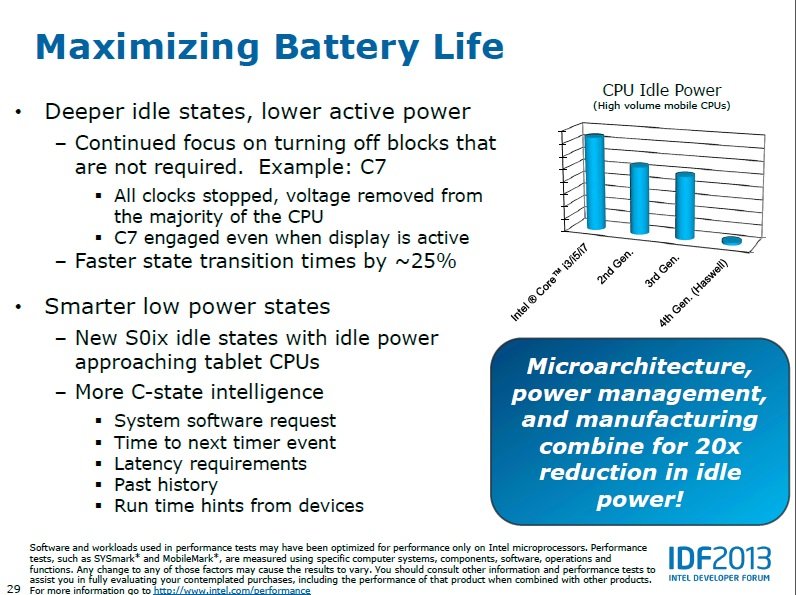
Intel Haswell Idle Chart
Intel designed the new C6 and C7 states to massively drop power consumption at idle at 0.05 amps in comparison to 0.5 amps with Ivy Bridge. That is a massive 10x lower idle power consumption. The issue arises and may not be an issue is due to most companies will tell you the maximum supported amps but usually leave out the minimum. This potential problem could only come up on older or cheaply made PSUs. Basically C6 and C7 power states could trigger Under Voltage Protection (UVP) on these PSUs and have issues. Intel has somewhat made this a non-issue though by instructing motherboard manufacturers to have these states disabled in the BIOS so that way all PSUs will be compatible.
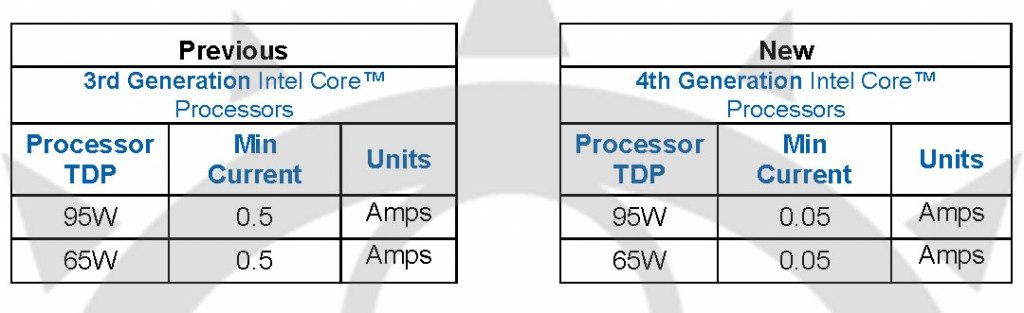
Intel Haswell Idle chart
It comes down to depending on your PSU you may not get the extra power saving but it by no means leaves you having to purchase a new PSU to use Haswell processors. While overclocking the new Haswell chips you would probably disable these states anyways, this will help out with the mobile market that is sure to take full advantage of these chips.
Strange…
What is strange, its is more a precaution than anything.
I see, so older PSU can still be used with the C6/C7 states disabled. Well, then it’s not a big issue.
Someone should make a complete list of supported/unsupported PSUs, would be smart for those seeking to buy a new 4th gen Intel CPU!
I suppose as far as problems go this is a rather nice sign for future energy efficiency.