
Intel Haswell Integrated Graphics Processor Iris Detailed
AMD has been burning up the market with their APUs for desktops and mobile devices as of late. Intel has had their “HD” integrated graphics processors (IGP) since Sandy Bridge but unless you were just trying to watch movies or play minesweeper you always have had discrete graphics card that replaced Intel’s on chip HD graphics. Well Intel today has released information and data on the next generation to go along with their new Haswell family of core processors. They have dubbed it GT3 “Iris”.
If you can think back all the way to September of 2012 we got our first glimpse of what new architecture Intel was trying to build. Intel’s developer conference gave tt had the potential of doubling the output of the IGP that were built into Ivy Bridge, which was GT2.
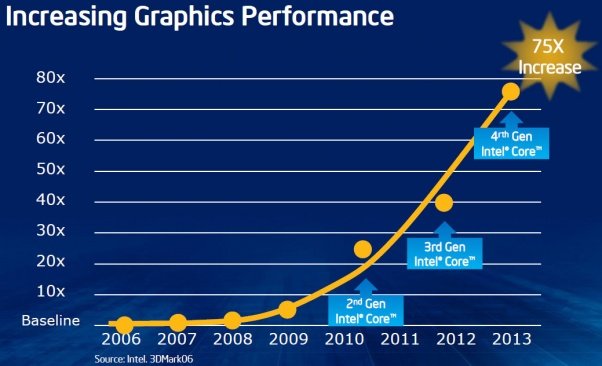
Intel Haswell Integrated Graphics Performance Exceptations
The above chart shows what Intel has been striving for in getting their IGP’s up to date and performing. Intel has been trying and successfully upgrading their IGP and according to their chart the new Iris graphics will be 75x better than what they started doing in 2006.
Intel Iris tiers and differences:
Now with the new Iris IGPs, Intel is breaking them up into serperate tiers. The top tier will be GT3e Iris Pro graphics 5200, GT3 (28W) Iris graphics 5100, GT3 (15W) HD graphics 5000, GT2 HD 4600 / 4400 / 4200 and these are typically what was with Ivy Bridge up upgraded and updated for Haswell. As you can see only the top two tiers will acutally have the Iris graphics IGP in them while the rest will have the HD 5000 or 4000 series. Here is a pretty good chart to give you a visual view of them also.
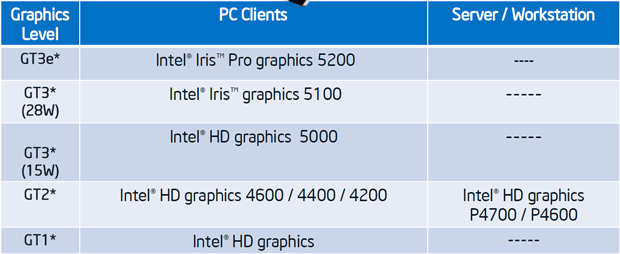
Intel Haswell Integrated Graphics Processor Tiers
Now lets go though the differences between these tiers. From the bottom of the chart we are going to skip GT1 tier since it will be used but nothing that would matter. When we step up to GT2 you will notice that this is still the 4000 series. Like I said earlier this is what came with Ivy Bridge and Intel has said they plan to still use this IGP but will have updated and tweaked it some for certain implementations. The next tier up is the GT3 15W variant. These IGPs will have the GT3 architecture but will not have the new Iris IGP. Moving to the GT3 28W variant and we look at the the first Iris IGP. According to Intel this will have “full” implementation of GT3 architecture up to 28 W for better performance over the 4000 and HD 5000 IGPs. Last but the most coveted of these will be the GT3e Iris IGP. The “e” means that this IGP will have embedded DRAM and also will have various power consumption levels according to Intel.
One can assume that the higher tiers will be on the higher rated chips but at this point since Haswell has not been released we do not know of the SKUs and what comes with what just yet.
Performance and Benchmarks:
Earlier in the article we showed you the performance levels Intel has been wanting to acheive with integrated graphics so now we can show you some general data on how well these new IGPs will perform. First up is a chart released of some of the lower level 4th generation chips from Intel for Ultrabooks.
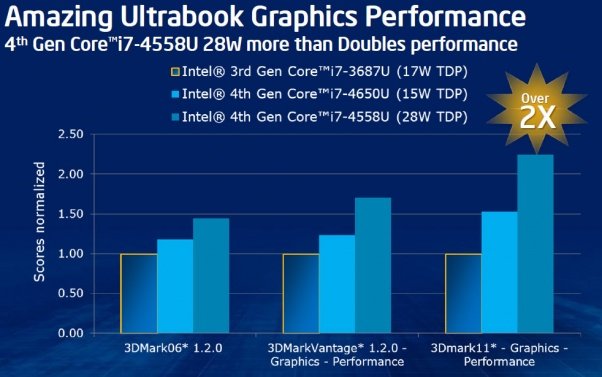
Intel Haswell Integrated Graphics Performance
As you can see from the chart the that the 17W Ivy Bridge (i7-3687U) and the 15W Haswell (i7-4650U) that it does perform better but looks to be in the 10% to 25% range depending on the benchmark you are using. If you compare the 17W Ivy Bridge again to the 28W Haswell (i7-4558U) then you start seeing some real performance between the 3rd and 4th generation. Now it looks to me while this is a pretty good gain you also have to remember the wattage nearly doubles to get those gains but is still pretty good results.
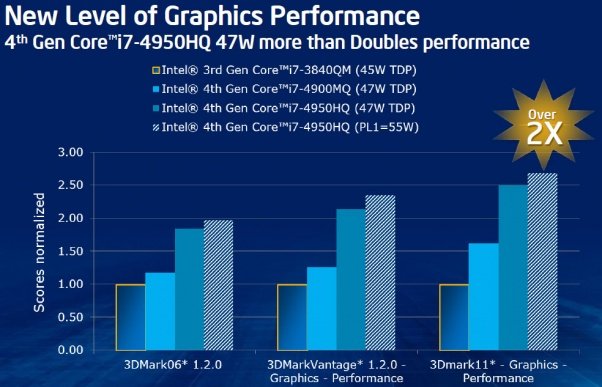
Intel Haswell Integrated Graphics Performance
Looking at the chart above you can see that while the wattage of the chip goes up so does the graphics performance for Haswell vs Ivy Bridge when getting into the higher powered notebook and laptop chips. This data is showing that using 3DMark11 that the 55W Haswell (i7-4950HQ) has over 2X the performance than the 45W Ivy Bridge (i7-3840QM). Intel also threw in two other chips for comparison sake that are around the same wattage and you still get decent gains from both of them. Rumors are swirling that anything in the “H” in the series will have the embedded DRAM built into the chip which would explain why both variants of the i7-4950HQ (47W and 55W) have significant gains over Ivy Bridge.
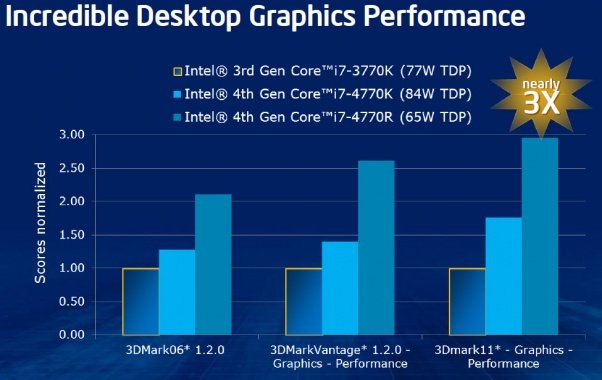
Now on to what everyone has been waiting on is the desktop performance. Well here it is!
Intel Haswell Integrated Graphics Performance
While the i7-3770k has been the top chip and a workhorse for anyone that has had it the new i7-4770k can now claim better performance in both processing and integrated graphics. As with the ultrabooks and notebooks we see a similar pattern of exponential increase in performance from the new IGPs. The enthusiast CPU of the bunch, the i7-4770k, get almost 3X the performance of the Ivy Bridge i7-3770k. While the i7-4770R doesn’t see the same jump in performance you still have a decent gain on the 3rd generation Ivy Bridge i7-3770k.
Final Thoughts:
Now as an enthusiast myself I don’t think I would ever use the integrated graphics from the i7-4770k. This is a sweet chip and Intel just keeps upping the ante especially with AMD going all out with their line of APU and all the improvements they have been able to put into them. These are just benchmarks and hopefully in the following month we will get some real game data from these chips to see how well they stack up not only to AMD’s APUs but discrete graphic cards as well to ascertain the possibly it is another option to the user. The user could buy one awesome chip and not needing to go out and buy an expensive discrete graphics card to play their favorite game. Time will tell and I for one am excited about the possibilities of Intel’s new Iris branded IGPs.
This is very interesting for the mobile sector. We are going to have ultrabooks more capable from the point of view of graphics and with less power consumption.
The rivalry between Ivy Bridge and AMD APUs is a good thing for us consumers.
I wish they’d just completely cut out the iGPU on the K series CPU’s – almost nobody who buys that CPU uses it, as it’s marketed for OC’ers mainly (being the “only” CPU that can be overclocked significantly).
It is exciting, I’m looking forwards to a nice GT3e laptop in the future.